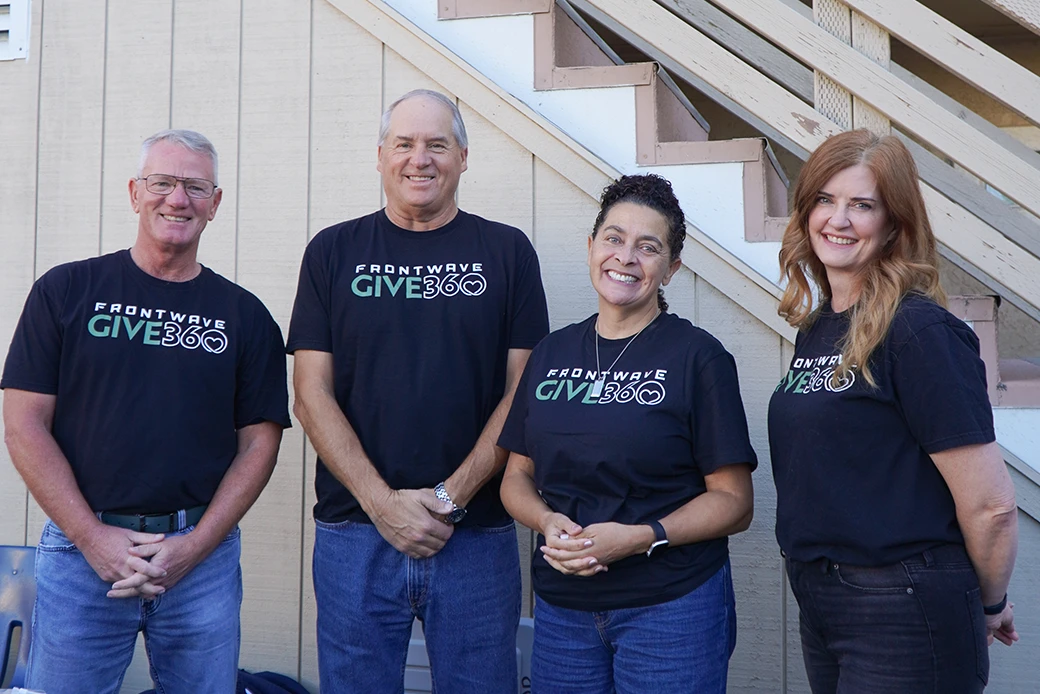
Showing Up for Our Communities
Through Frontwave Give360, we support local organizations and causes that strengthen the communities we call home.
Through Frontwave Give360, we support local organizations and causes that strengthen the communities we call home.

Use the value you've built to renovate, consolidate, or fund what's next.
Lending options tailored for hardworking business owners like you.
Insights on money, life, and the communities we serve.
Turning compassion into action through grants, scholarships, and support for local nonprofits.
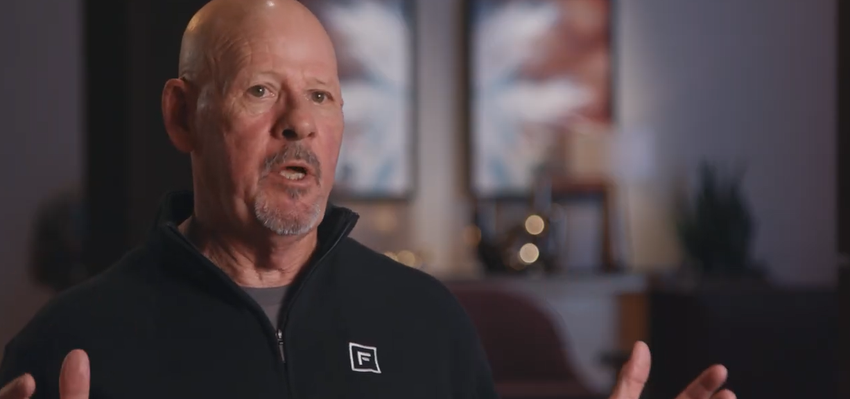
In today’s rapidly evolving financial landscape, the role of C-level leaders in banks is more critical than ever. These leaders must navigate complex regulations, drive innovation, maintain financial stability, and foster a strong organizational culture. What does it take to be an effective leader at this level? We had the pleasure of interviewing Bill Birnie, President & CEO, Frontwave Credit Union based in Oceanside, California.
Bill Birnie is the President and CEO of Frontwave Credit Union in Oceanside, California, bringing to the role a leadership approach shaped by 25 years in the United States Marine Corps. He often points to the Corps as the place where he found purpose and discipline, saying it taught him that his early “poor performance in high school wasn’t due to a lack of intellect” but a lack of motivation. His military service took him around the world as a Marine Security Guard, introduced him to diverse cultures, and led to meeting his wife, Linda, before he returned home to earn degrees in finance, banking and international business. After retiring from the Marines in 1997, Birnie entered the credit union world with guidance from the late Lou DeCarlo, a CEO he credits as a mentor who “invested in me,” sending him to management school and helping set the path toward senior leadership. Birnie, who has led credit unions through challenges including the Great Recession, is known for a philosophy that centers on trust, accountability and surrounding himself “with people far smarter than I am” to achieve shared goals.
************************
Thank you so much for your time! I know that you are a very busy person. Our readers would love to “get to know you” a bit better. Can you tell us a bit about your ‘backstory’ and how you got started?
After a less than stellar academic performance in high school I was a bit lost and was trying to figure out what’s next for me. Ultimately, although I didn’t know it at the time, I made the first of a select few decisions that shaped my life. I enlisted in the United States Marine Corps. The Marine Corps gave me purpose, discipline and an additional 25 years of adult leadership. I learned that my poor performance in high school wasn’t due to a lack of intellect. Rather, it was due to a lack of motivation. The Marine Corps fixed that problem too! When I learned that Marines guarded the United States Embassies and Consulates around the world, I applied and was accepted to serve as a Marine Security Guard. Important, life shaping decision number two! Working at various US Embassies exposed me to the smart, dedicated Americans serving our nation from abroad as well as the opportunity to experience numerous cultures around the world. Most importantly, I met the lovely Miss. Linda while serving at the American Consulate in Casablanca, Morocco. Life shaping decision number three. Linda and I married in December 1979 and in a few short months we will be celebrating our 46th anniversary. After several years serving abroad, I realized that I needed to get a college education. So, when we returned to the United States, I started going to college in between deployments and eventually earned a BBA in Finance and Banking and an MBA in International Business. Life shaping decision number four! I had my degree wrapped up but I still had eight years to go before retirement from the Corps. That’s when I decided to become a volunteer at my credit union. Life shaping decision number five! I have been blessed with two careers I love. I loved being a Marine and I love the credit union movement. And… I still get to take care of Marines! As the President and Chief Executive Officer of Frontwave Credit Union.
Is there a particular book that made a significant impact on you? Can you share a story or explain why it resonated with you so much?
“We Were Soldiers Once, and Young” written by Lt. Gen. Harold Moore and Joseph Calloway. I found it to be an excellent example of the need to consistently train to hone your skills and develop creative new ways to engage. The battle depicted in the book completely changed the war in Vietnam. It’s a story of leadership, courage and a steadfast commitment to each other and the mission. They studied their environment, conceived potential outcomes and as the battle developed, effectively shifted strategies. To me this is not at all dissimilar to leading a credit union. We assess our environment — regulatory issues, legislative initiatives, competitive market, regulatory issues, Member expectations and economic pressures. We model various scenarios to determine potential impacts. We plan what shifts may be necessary to mitigate risk or pursue my preferred posture of taking advantage of the environment to meet rising consumer desires and grow.
None of us can achieve success without some help along the way. Is there a particular person that you are grateful for, who helped get you to where you are? Can you share a story?
When I became a volunteer at Frontwave Credit Union I had the opportunity to meet and interact with then CEO, Lou DeCarlo, at Board meetings and strategic planning sessions. When I retired from the Marine Corps in 1997, Lou hired me as an Internal Auditor. First, he farmed me out for three months working under a friend of his that ran a CPA firm that specialized in credit unions so I could learn how to audit. Lou DeCarlo mentored me and introduced me to many key leaders within the credit union movement. He also sent me to Western Credit Union Management School in 2002. I recognized the importance of this investment in me, and I did not want to let Lou down. I worked hard, studied hard and ultimately graduated as the top student in my class. In addition, I was selected by my peers to receive a leadership award and deliver the commencement speech at graduation. I credit my work as a student and leader within my class as well as the exposure it gave me to my becoming a CEO within the credit union movement. Sadly, we lost Lou in May of 2004. I am, and will forever be, immensely grateful for Lou DeCarlo. I hope I’ve made him proud.
Can you share a funny mistake that you made when you were first starting out?
As mentioned earlier, I served in the United States Marine Corps for 25 years and retired from the Corps as a Sergeant Major in 1997. The vast majority of the time I was in the Marines I was in units that were 100% male. If you’ve seen a few movies about the Marines, (Full Metal Jacket comes to mind) you know that they have a very colorful vocabulary riddled with expletives. In many cases, to those outside the Corps, they made no sense at all. As mild example, the hat (Marines call it a Cover) that is vertical from front to back in Marine vernacular is called a Piss Cutter. To this day, I don’t know why. In any case, we have a lot of that kind of stuff. With that preamble, me spending many years in an all-male environment with colorful language, it may not be difficult to surmise that my transition into the start of my career in credit unions, which was at the time a predominately female environment, might have been a bit bumpy. I stumbled a few times in the beginning and tried to be cautious but, on one particular day I was focused on a document I was drafting when female VP behind me asked about the status of one of our ATMs. Without a thought, or even looking up, I used one of those colorful phrases (I won’t tell you what it was) that meant the ATM was dead. The next thing I heard was a loud, “What did you just say?” Fortunately, this VP was the wife of a retired Marine. Consequently, I received a very stern lecture as to what is appropriate and what is not appropriate in the workplace. To this day, I remain ever vigilant to be truly professional in appearance, behaviors and communications.
How do you define ”Leadership”? Can you explain what you mean or give an example?
My leadership style was honed by the Marine Corps traits and principles. Leaders set an example by modeling the passion, commitment and behaviors they want to see within the organization. They must communicate effectively and recognize the power of their words. I’ve always believed that I should surround myself with people far smarter than I am, articulate my vision for the organization, provide them with the resources needed for success and then get out of their way. As Steve Jobs put it, “It doesn’t make sense to hire smart people and then tell them what to do; we hire smart people so they can tell us what to do.” In my observations, the best leaders build relationships with trust and a mutually shared vision.
Can you share an example of a challenging decision you faced as a C-level leader and how you navigated it?
I have had the privilege of leading two different credit unions over the past 18 years. I took the helm of my first credit union in November 2007. Thus far that year, the credit union had lost over $900 thousand. I knew that and during my preparations prior to interviewing for the job, I thought I had a pretty good idea why. What I didn’t know is that the Great Recession was right around the corner. Between 2007 and the end of 2009, the credit union lost $9 million. In my mind, I was facing challenges on two fronts — we had to return the credit union to financial health, or we would be conserved by our regulators, and I perceived a tremendous need to transform the culture of the organization. To get our financial posture in order we focused heavily on expenses, re-negotiated contracts, sought out new sources of revenue and rightsized the organization. To transform the culture, I continuously modeled the behaviors I wanted to see, articulated standards and held everyone accountable to them. I took actions to have the right people on the bus in the correct seats, and I encouraged voluntary participation in community events and supported the philanthropic activities of our primary source of Membership to bring our people together to build comradery and contribute to a good cause.
How do you balance the demands of regulatory compliance with the need for innovation and growth within your bank?
Unfortunately, failing to maintain compliance with laws and regulations is a precursor to regulatory ire and being served with a lawsuit. Ultimately, you don’t have much of a choice. We try to ensure that our resources are focused on supporting our strategic direction by prioritizing projects and building tactical plans throughout the organization so that teams are aligned and working cross-functionally to reach our goals.
How do you foster a culture of ethical behavior and integrity within your organization?
Integrity, professionalism and ethical behavior are table stakes. Without them, you can’t build trust, and trust is critical in relationships. Leaders need to provide a model that is worthy of emulation. They need to set the standard and hold their teams accountable for those standards. Once they’ve built the desired culture, they must continually tend to its care and feeding because, culture is like a rubber band — you can stretch it the shape you want but, the second you let go, it returns to its original shape.
What strategies do you use to stay ahead of industry trends and ensure your bank remains competitive in the market?
I start by reading the news every day from multiple industry media sources. I also closely follow communications from our trade associations such as America’s Credit Unions and the California Credit Union League. I attend industry conferences and meetings to connect with my peers, listen to and consider the perspectives of thought leaders and, on occasion, commiserate with my professional friends.
What are “5 Things You Need To Be A Highly Effective C-Level Leader Of A Bank”?
How can our readers further follow your work?
You can check us out and keep up with what we are doing at frontwavecu.com, you can follow us on our socials, or you can connect with me via LinkedIn.
Thank you so much for sharing these important insights. We wish you continued success and good health!
Internet Explorer is no longer supported by Microsoft. Please update to Microsoft's latest browser Microsoft Edge. Please note that even Microsoft's website cannot well-support this browser. Navigating to the link in this message will result in you being directed to a "Download Microsoft Edge" page with license terms and an "Accept and download" button.
You are leaving the Frontwave Credit Union website. External third-party web sites will be presented in a new and separate content window. Frontwave Credit Union does not provide, and is not responsible for, the product, service, overall website content, accessibility, security or privacy policies on any external third-party sites.